научный
журнал
Срочная публикация научной статьи
+7 995 770 98 40
+7 995 202 54 42
info@journalpro.ru
Strategic approaches to personal brand promotion in the confectionery industry
Рубрика: Социологические науки
Журнал: «Евразийский Научный Журнал №2 2026» (февраль, 2026)
Количество просмотров статьи: 436
Показать PDF версию Strategic approaches to personal brand promotion in the confectionery industry
Saveliia Solntseva
Cake artist and edible sculptor
Toronto, Canada
Abstract. The article examines a strategy for personal brand promotion in the confectionery industry in the context of digitalization and increasing competition within the small business segment. The relevance of personal branding as a tool for building trust-based relationships with consumers and enhancing entrepreneurial effectiveness is substantiated. Based on an analysis of scholarly approaches to the concept and structure of a personal brand, its key components are systematized and their industry-specific characteristics in relation to the confectionery field are identified. The study explores contemporary and accessible personal brand development tools oriented toward individual entrepreneurs and small business representatives. As a result of the conducted synthesis, the author proposes an original strategy for planning personal brand development in the confectionery industry, grounded in the gradual formation of professional identity, brand structuring, coordinated selection of tools, and performance evaluation. The findings may be applied in the practical activities of emerging entrepreneurs.
Keywords: personal brand; personal branding; promotion strategy; confectionery industry; small business in the confectionery industry; individual entrepreneurship; digital communications; social media; visual identity; consumer trust.
In the context of economic digitalization and the transformation of marketing communications, the personal brand is becoming one of the entrepreneur’s primary intangible assets, the significance of which is particularly evident within small business segments. The contemporary consumer increasingly focuses not only on the functional characteristics of a product but also on the personality of its creator, their values, story, and level of openness. Consequently, a gradual shift is occurring from product- and corporate-centered promotion toward a human-centered model of market interaction, within which the personal brand serves as a tool for building trust-based relationships.
At the same time, the relevance of personal brand development is increasing against the backdrop of growing competition and information overload in the digital environment. As rightly noted by N.P. Ketova and Y.E. Tokareva, the contemporary consumer information space is characterized by a high level of informational noise, as a result of which impersonal advertising messages are often ignored, increasing the demand for personalized communication [4]. Under these conditions, an entrepreneur’s personal brand makes it possible to form a unique image in the minds of the audience, enhance recognition and loyalty, and, consequently, improve the commercial effectiveness of a business. It is widely accepted that trust in the individual behind a product has historically been a key factor in consumer choice and continues to retain its significance in the context of the digital economy.
In particular, the personal brand acquires a special role in areas where the product is closely associated with emotions, aesthetic preferences, and the subjective perception of quality, including the confectionery industry. In this field, trust in the creator, their reputation, and individual style often becomes no less important than the product’s recipe or existing pricing policy. In small and microbusinesses, where marketing budgets are limited, the personal brand also serves as a compensatory mechanism for competitiveness and customer acquisition.
At the same time, it is important to emphasize that the widespread adoption of social networks and network-based forms of communication has significantly influenced the development of personal branding. According to the study by M.D.M. Cullen, A.P. Calitz, and A. Botha, this process is associated with the impact of social media on opportunities for self-presentation and network interaction. At the present stage, the personal brand has become an accessible tool not only for public figures but also for representatives of small businesses. The authors identify two possible dimensions of a personal brand — interpersonal branding, based on trust, interaction, and social capital, and intellectual branding, associated with the demonstration of professional competencies and expertise. For entrepreneurs in creative niches, the combined development of these components enables the establishment of effective relationships with the target audience [1].
Drawing on research findings, the theoretical interpretation of the personal brand phenomenon also confirms its universal nature, since, according to the concept proposed by M. Khedher, a personal brand exists for every individual regardless of their level of awareness or public visibility; however, it is precisely its deliberate management that transforms it into a strategic resource. In this regard, it is particularly noteworthy that the author considers personal branding as a planned process that involves identity formation, positioning, and image evaluation [5]. Conversely, the absence of personal brand management leads to the spontaneous formation of an image that may not align with professional and commercial objectives.
Thus, the relevance of studying a personal brand promotion strategy in the confectionery industry is determined by a combination of factors, including the increasing role of trust and personalization in consumer behavior, the development of digital communications, the specific characteristics of the confectionery field, and the need to identify accessible and effective promotional tools for emerging entrepreneurs. Considering the above, the systematization of scholarly approaches to personal branding and their interpretation in light of the specific features of the confectionery industry appears to be a significant and timely research objective.
The aim of the study is to develop and substantiate a strategy for promoting a personal brand in the confectionery industry, taking into account industry-specific characteristics as well as the resource constraints of small businesses and individual entrepreneurship.
The research materials included scholarly publications by domestic and foreign authors devoted to the issues of personal branding, marketing communications, and entrepreneurial activity in the digital environment. The study draws upon works that examine the concept and structure of the personal brand, its functions and development tools, as well as research reflecting the specific features of promotion within the confectionery industry.
The methodological foundation of the study is based on general scientific and specialized research methods. Methods of analysis and synthesis were applied to generalize theoretical approaches to personal branding; the structural-functional method was used to identify the key components of a personal brand and their interrelationships; comparative analysis was employed to reveal the industry-specific characteristics of the confectionery field; and a systems approach was applied to develop the author’s personal brand development strategy as a model. In addition, the method of logical modeling was used to formulate the stages of the strategy and to generalize the research findings.
The application of the aforementioned methods made it possible to formulate practice-oriented conclusions aimed at increasing the effectiveness of personal brand development in the confectionery industry.
In the scholarly literature, a personal brand is considered a multi-component socio-communicative construct, the formation of which occurs at the intersection of professional competencies, individual personality traits, and the ways they are represented in the public sphere. Despite the diversity of interpretations, most researchers agree that a personal brand is not solely an image-based or marketing phenomenon, but rather a formed perception of an individual in the minds of the target audience that directly influences trust, choice, and loyalty.
From the perspective of applied marketing, a personal brand is defined as the informational and reputational footprint of an individual. Thus, A. Ibrakhimi, for example, interprets a personal brand as a set of perceptions about a person formed on the basis of publicly available information, primarily within the digital environment. According to the author, a personal brand is not only who a person objectively is, but also how they seek to be perceived by others. At the same time, it is fundamentally important that the foundation of a personal brand consists of realized professional competencies confirmed by practice and measurable results [2]. In this regard, a personal brand may be viewed as a consequence of professional credibility. In addition, functionally, a personal brand performs the following tasks: shaping a positive perception of the individual, building trust-based relationships with clients and partners, differentiation from competitors, strengthening reputation, and increasing recognition.
A noteworthy aspect is also the structural interpretation of the personal brand presented in the model developed by A.A. Orel and A.A. Gorenko. The authors propose viewing a personal brand as a system of interrelated elements that form a unified professional image (represented by six components, Fig. 1) [8].
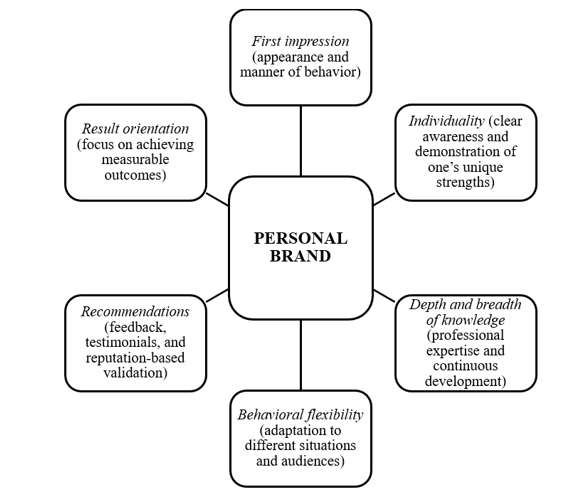
Fig. 1. Elements forming a personal brand in its classical interpretation, compiled by the author based on [8].
Based on the characteristics outlined above, it should be noted that a personal brand is formed through the systematic development of both personal and professional qualities. At the same time, it is important to mention that contemporary research expands classical structural models by placing emphasis on the emotional and value-based components of a personal brand. Thus, E. Kobzeva considers a personal brand as an integration of professional competencies, communication style, visual identity, and values, highlighting the necessity of maintaining authenticity alongside emotional engagement with the audience. The author notes that within the digital environment, a personal brand transforms into an independent business model around which loyal communities are formed, grounded in trust and identification with the entrepreneur’s personality [6]. Moreover, visual identity is also regarded as an integral attribute of a personal brand.
Thus, a personal brand can be defined as a systemic construct that includes professional competencies, individual qualities, values, visual and communicative identity, as well as reputation (validated). The structure of a personal brand is formed through the process of conscious self-positioning and is aimed at creating a trust-based and differentiated image in the minds of the target audience, which serves as a theoretical foundation for further research into its industry-specific characteristics and development tools within the confectionery industry.
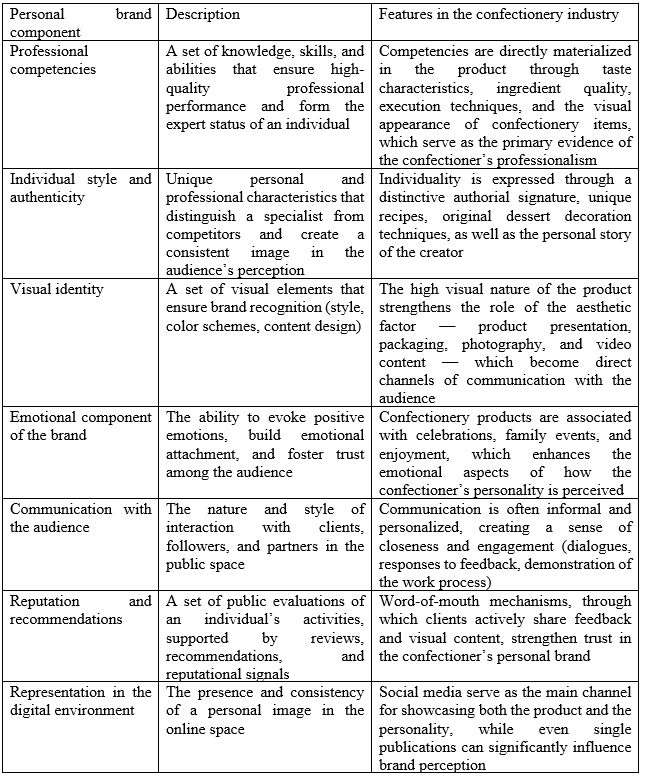
With regard to the latter, despite the universal nature of the personal brand structure, its practical implementation varies significantly depending on industry-specific characteristics. The confectionery industry belongs to the segments of the creative economy, where a product is perceived simultaneously through functional attributes as well as visual, emotional, and symbolic parameters. In this context, the personal brand of a confectioner is formed at the intersection of professional craftsmanship, aesthetic perception, and trust-based relationships with consumers (Table 1).
Table 1. Key components of a personal brand and their specific features in the confectionery industry
Source: compiled by the author based on [7; 10].
In the most general sense, according to Table 1, the specific features of a personal brand in the confectionery industry lie in the dominance of visual-aesthetic and emotional components while preserving the fundamental role of professional competencies and authenticity. The personal brand of a confectioner is formed as an image that combines product quality, individual style, visual identity, emotional engagement with the audience, and reputation. This combination of elements distinguishes the confectionery industry from other segments of entrepreneurship and imposes specific requirements on the development of general (universal) models of personal branding within industry-specific conditions.
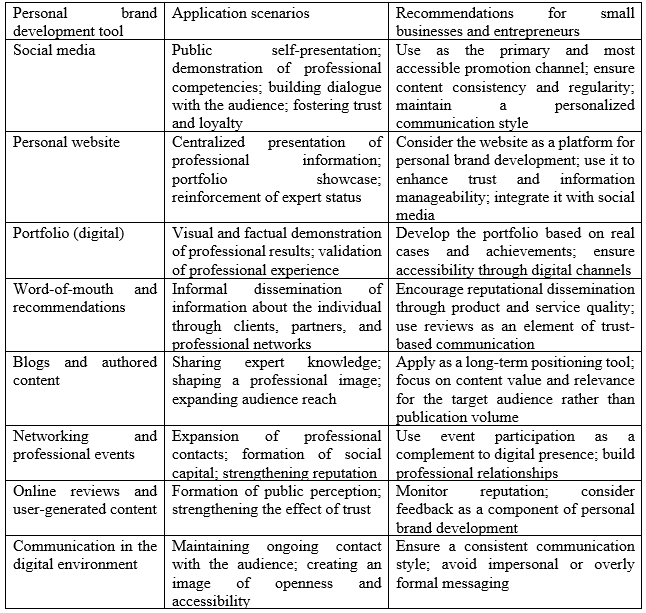
In particular, based on the identified characteristics, it appears possible to specify the tools for personal brand development and the scenarios for their application (Table 2):
Table 2. Personal brand development tools and scenarios for their application
Source: compiled by the author based on [3; 9].
Based on the presented tools, it is evident that digital promotion instruments are primary for small entrepreneurship, as their use implies maintaining a personal blog and gradually accumulating a client base (through the collection of reviews and feedback, as well as iterative improvement). In order to ensure the manageability of a personal brand, it is important to adhere to specific strategies; in this regard, the author’s strategy for planning personal brand development in the confectionery industry becomes a universal approach.
This strategy is oriented toward individual entrepreneurs and representatives of small businesses and takes into account the industry-specific characteristics of confectionery activity; its foundation is based on approaches to personal branding, the structural elements of a personal brand, and accessible tools for its development.
The author’s strategy for developing a confectioner’s personal brand is based on the principle of stage-by-stage progression and the interconnection of actions; each stage of the strategy builds upon the results of the previous one and forms a unified model of long-term personal positioning within the professional environment (Fig. 2).
Thus, the author’s strategy for personal brand development in the confectionery industry represents a model based on the alignment of an individual’s professional identity, the structural elements of the brand, and accessible promotional tools. The implementation of this model makes it possible to consider a personal brand as a long-term strategic resource aimed at ensuring business competitiveness within the confectionery industry.
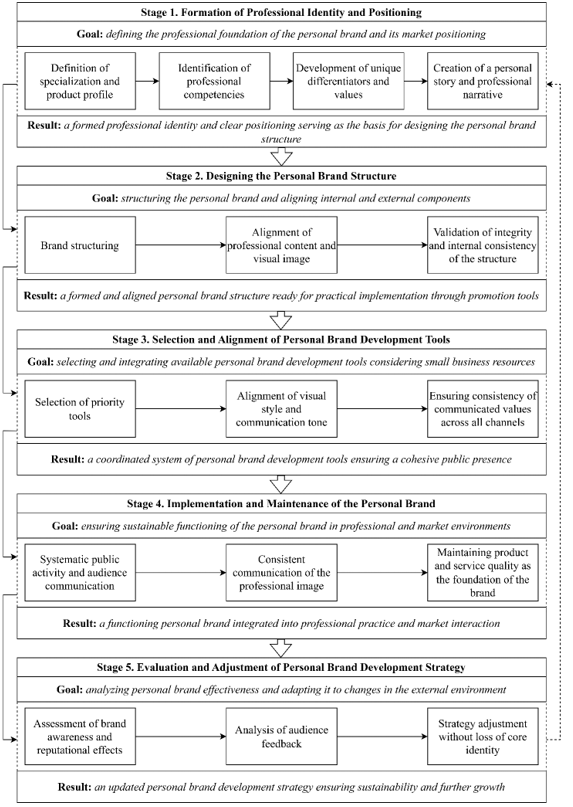
Fig. 2. Author’s strategy for planning personal brand development in the confectionery industry, developed by the author.
Based on the proposed model, the following recommendations can be formulated as an application to it; for the purpose of personal brand development, entrepreneurs are advised to:
Consider a personal brand as a strategic resource, the formation of which depends on consistency, systematic development, and a long-term orientation.
Begin personal brand development with professional identity, clearly defining one’s specialization, values, and unique characteristics. In the confectionery industry, particular importance lies in the awareness of one’s distinctive authorial style and product focus.
Ensure the coherence of the personal brand structure (professional competencies, visual image, communication style, and reputational elements), as all components should complement one another and form a holistic personal image.
Use accessible promotional tools consciously, prioritizing channels that provide direct contact with the audience and correspond to the resource capabilities of small businesses. Visually oriented digital platforms and reputation-based mechanisms possess the greatest potential for the confectionery industry.
Pay close attention to product quality and real customer interaction experience, since these factors form the foundation of trust and trigger word-of-mouth information dissemination.
Regularly evaluate and adjust the personal brand development strategy, ensuring its alignment with market changes, consumer expectations, and professional goals, while preserving personal identity as its core foundation.
Thus, the distinctive feature of a personal brand in the confectionery industry lies in the significant role of visual-aesthetic and emotional components, while professional competencies and the actual quality of the product remain the foundation of the brand. The personal brand of a confectioner is formed as an image that integrates craftsmanship, individual style, visual identity, emotional engagement with the audience, and reputational information dissemination. The inconsistency of these elements or attempts to replace professional substance with external self-presentation lead to a decline in trust and the loss of reputational potential.
Overall, a personal brand in the confectionery industry should be viewed as the result of the integration of professional craftsmanship, personal values, and the competent use of communication tools, as its purposeful and consistent development enables emerging entrepreneurs not only to increase recognition and audience trust, but also to ensure business effectiveness in conditions of high competition and a dynamically changing market environment.
References:
1. Cullen M.D.M., Calitz A.P., Botha A. The use of social media for personal branding // Proceedings of the International Business Conference (IBC-2024). 2024. P. 1–10.
2. Ibrakhimi A. Development of a personal brand // Journal of Applied Research. 2022. Vol. 4. No. 6. P. 311–316. (In Russian).
3. Karaduman I. The effect of social media on personal branding efforts of top level executives // Procedia — Social and Behavioral Sciences. 2013. Vol. 99. P. 465–473. DOI: 10.1016/j.sbspro.2013.10.515.
4. Ketova N.P., Tokareva Yu.E. The entrepreneur’s personal brand as a communication tool in the management of a commercial organization // Bulletin of the Expert Council. 2022. No. 2 (29). P. 45–50. (In Russian).
5. Khedher M. Personal branding phenomenon // International Journal of Information, Business and Management. 2014. Vol. 6. No. 2. P. 29–40.
6. Kobzeva E. Personal brands as the new business model: how experts, coaches, and freelancers can leverage social media to grow // Universal Library of Innovative Research and Studies. 2025. Vol. 2. No. 1. P. 38–43. DOI: 10.70315/uloap.ulirs.2025.0201009.
7. Kuchmezova A.A., Blyanikhov A.T., Yaitskaya E.A. Promotion of confectionery brands on social media // Economy and Society. 2022. No.
8. Orel A.A., Gorenko A.A. Personal branding. A model of an effective personal brand // APRIORI. Humanities Series. 2014. No. 1. P. 32. (In Russian).
9. Taranova Yu.V. Personal brand: concept, tools, and stages of formation // Russian School of Public Relations. 2017. No. 9. P.
10. Vasconcelos L. Personal branding on social media: the role of influencers // E-Revista de Estudos Interculturais do CEI—ISCAP. 2021. No. 9. P.